8f4e

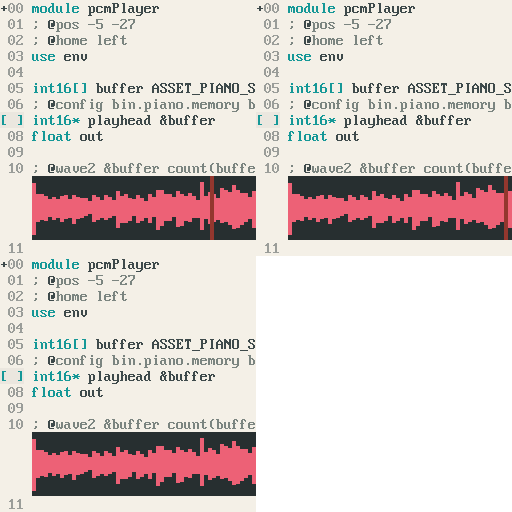
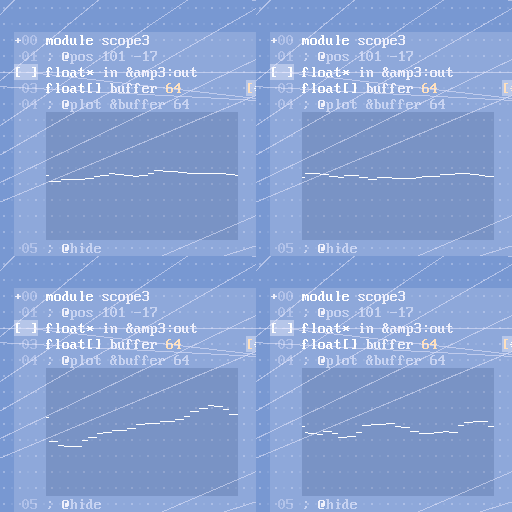
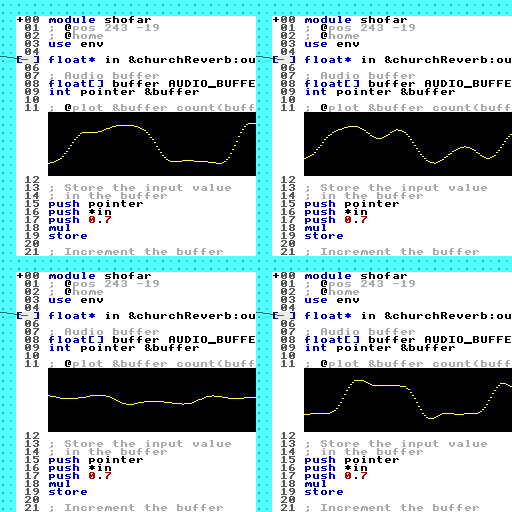
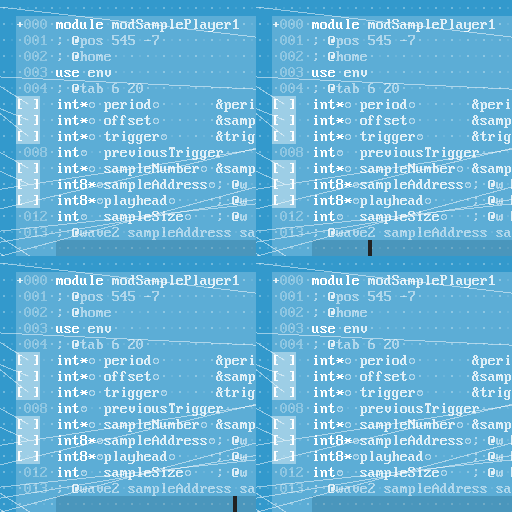
8f4e is a stack oriented programming language with a visual code editor that I created to perform generative music at algorave events.

Its primary target is the WebAssembly virtual machine, as I wanted an efficient yet portable tool for real time audio signal generation and processing.

Launch the Editor

Stack Oriented Execution Model

Stack oriented programming means that instead of using registers, instructions take their operands from a stack, and push their results back onto the same stack for the next instruction.

I chose this programming paradigm because the WebAssembly virtual machine is itself a stack machine.

Staying native to this execution model avoids costly abstractions and makes it possible to build a simpler and faster compiler.

...
067 push 2
068 push 3
069 ; Pushing values 2 and 3
069 ; onto the stack.
070 add
071 ; After executing the
071 ; add instruction,
072 ; the stack will contain
072 ; the value 5
073 push 10
074 mul
075 ; Now the stack will
075 ; contain the value 50
076 push 10
077 div
078 ; Now 5 again
...

Memory Access and Pointers

In 8f4e memory addresses are determined by the compiler, therefore dynamic memory allocation is not possible.

One advantage of this design is that memory addresses can be inlined compile time, which allows for faster access and less runtime overhead.

...
003 int result 
...
069 push &result
070 ; The variable name
071 ; prefixed with &
072 ; gives its memory address.
073 push 42
074 store
075 ; The store instruction
076 ; takes two values:
077 ; a memory address
078 ; and the value to store.
...

All memory items are laid out sequentially within the memory, so variables declared one after another occupy adjacent memory locations.

They're allocated on a 32-bit grid, which means that every memory item starts at an address that is a multiple of 4 bytes.

003 int   a 42
004 
005 float b 3.14
006 ; Memory address of b
007 ; is address of a + 4
008
009 int   c -5
010 ; Memory address of c
011 ; is address of b + 4

Endless Execution Loop

Programs in 8f4e run inside an endless loop. This reflects how real time audio systems operate, where processing consists of continuously reading from and writing to audio buffers.

8f4e removes this control flow boilerplate and allows programs to focus purely on signal generation and transformation.

Modules and Execution Order

The code is organized into modules, each containing variable declarations and a sequence of commands.

The execution order of the code modules is determined by their dependencies. If a module's output is needed as input for others, it is executed first.

...
001 module foo
002
003 int  a 10
004 int  b 20
005 int  result
006
007 push &result
008 push a
009 push b
010 add
011 store
012
013 moduleEnd
...

Live Variable Editing

It supports real-time manual modification of variable values while the program is running, without needing recompilation.

This is made possible by the deterministic allocation strategy: because memory addresses are fixed at compile time, the compiler can provide the exact address of every memory item, allowing the editor to locate and update any variable directly in memory.

...
003 int foo 10
004 ; You can change these
005 ; values in the editor
006 ; while the program is running.
007 float bar 3.14
008 ; The editor will trace
009 ; them back in the memory
010 ; and update their values
011 ; without restarting
012 ; or recompiling the program.
...

All variables in 8f4e are inherently public, with no option to modify visibility.

Also, it's not memory safe, pointers can point to anything within the memory space of the program, but the wires help developers to find where their pointers are pointing.

...
003 int* pointer
004
005 push &pointer
006 push pointer
007 push 4
008 push add
009 store
010 ; pointer will iterate through all
011 ; possible memory addresses.
...